Physical AI · Humanoid Robots
Google DeepMind's New Robot AI Gets a Mercedes Factory Trial
Google DeepMind says its new robot model ran Apptronik humanoids on a Mercedes-Benz line, succeeding 96% of the time. One robotics CEO says customers live in the last 4%.
· 2 min read
- GOOGL
- MBG
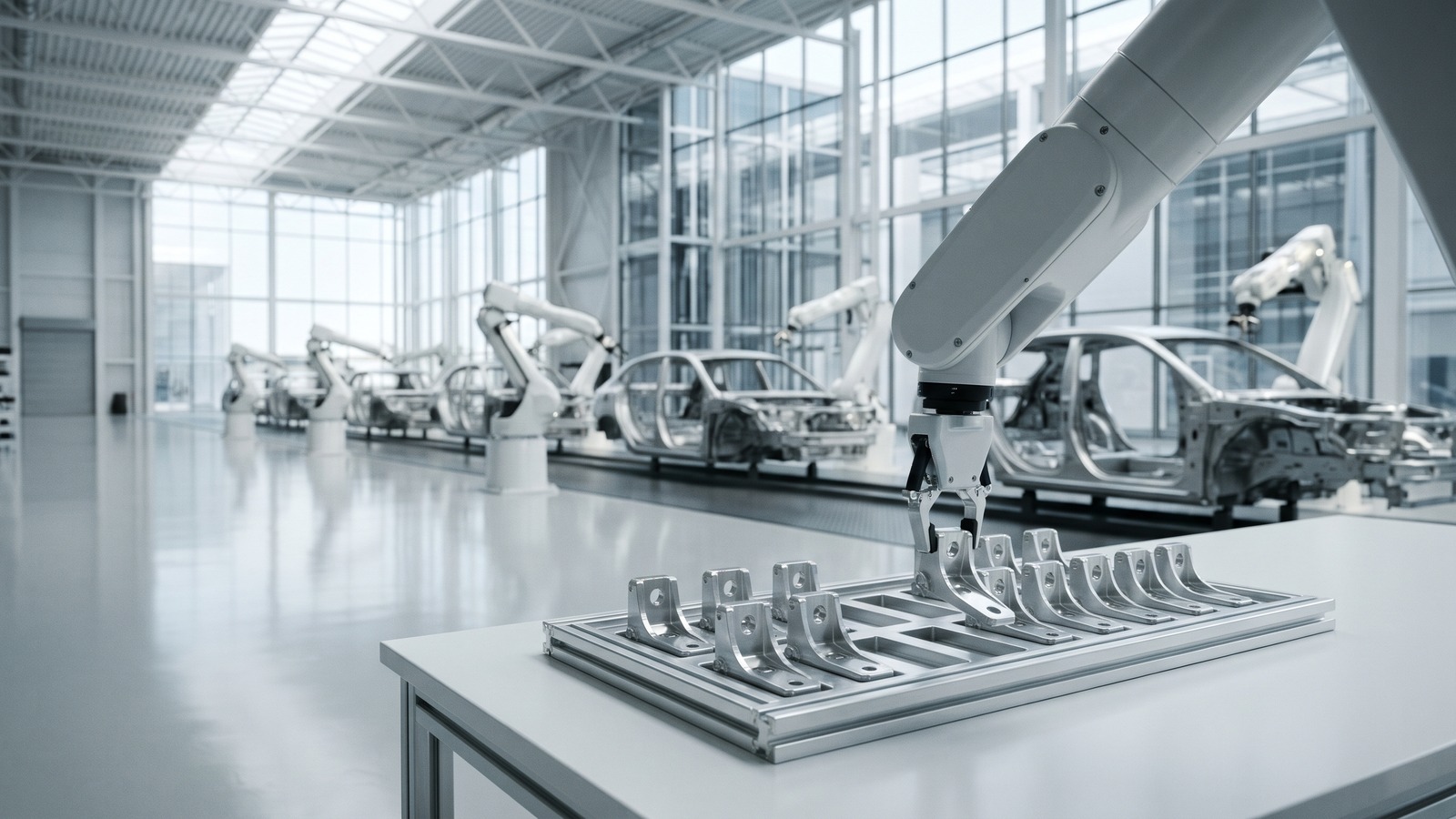
Google DeepMind tested its new Gemini Robotics 2.5 model on live Mercedes-Benz lines at two plants, in Germany and Hungary, with Apptronik humanoids kitting car parts in a proof of concept.
Kitting feeds an assembly line the parts each vehicle needs, in the order it needs them, so every miss lands on a line that keeps moving. At 96%, 4% of the work still falls short, and DeepMind did not say how many attempts the figure covers or what counts as a success.
What did the robots do?
Kitting means pulling parts from bulk bins and laying them out in trays in assembly order. In the trial, DeepMind said, Apptronik’s Apollo 2 took metal brackets from supply bins and set them in sequencing containers, working on its own.
Two models split the job. DeepMind’s embodied reasoning model, Gemini Robotics ER, kept track of the steps, and Gemini Robotics 2.5 controlled the hands and arms. The runs took place at Mercedes-Benz plants in Sindelfingen, Germany, and Kecskemét, Hungary.
What else does DeepMind claim?
DeepMind tested the model on more than 200 tasks, from serving food with tongs to tying a bow on a gift box. Success rates ran 30% to 100% higher than the model’s previous baselines, depending on the task, and work finished 20% to 30% faster. Safety guidance built into the model raised safe task completion by 33% around obstacles and 43% around nearby people.
Gemini Robotics 2.5 is rolling out to DeepMind’s robotics partners. With no price announced, a manufacturer cannot yet set the model’s cost against the labor the robots would replace.
How does DeepMind test for misuse?
DeepMind open-sourced ASIMOV-Jailbreak, a benchmark of hundreds of prompts that hide unsafe requests inside dozens of scenes. Gemini 4 Argon, the DeepMind model that sped development of Gemini Robotics 2.5 by generating simulated practice runs, resisted 99.5% of them. Gemini Robotics ER 2, DeepMind’s previous baseline, resisted 82%.
Is 96% enough?
A robot that resists misuse still has to get the work right. LightSpeed founder and CEO Biju Kulathakal, whose company applies robotics and AI to construction, commented on the announcement on LinkedIn: “on a real line, customers live in the 4%.”
A kit that needs 10 picks, each 96% likely to succeed independently, comes out right about 66% of the time. That is The Denominator’s illustration, not a reported result, but it shows how small misses compound across a kit.
For a manufacturer weighing humanoids, the question is what a 4% miss rate costs on its own line: how many parts per shift go wrong, and who catches them before the line stops.